You know your regulars by face.
But could you message them tomorrow?
Do you have their name, phone number, email address, order history, and a record of what they usually buy?
For many independent restaurants, the answer is surprisingly close to no.
The customers are real. The orders are real. But the relationship may be happening through someone else’s platform.
And in 2026, that’s becoming a bigger problem.
What Is Restaurant Customer Data?
Restaurant customer data is the information your restaurant collects about the people who order from you — their contact details, order history, visit frequency, preferences, and loyalty activity, gathered with the appropriate consent.
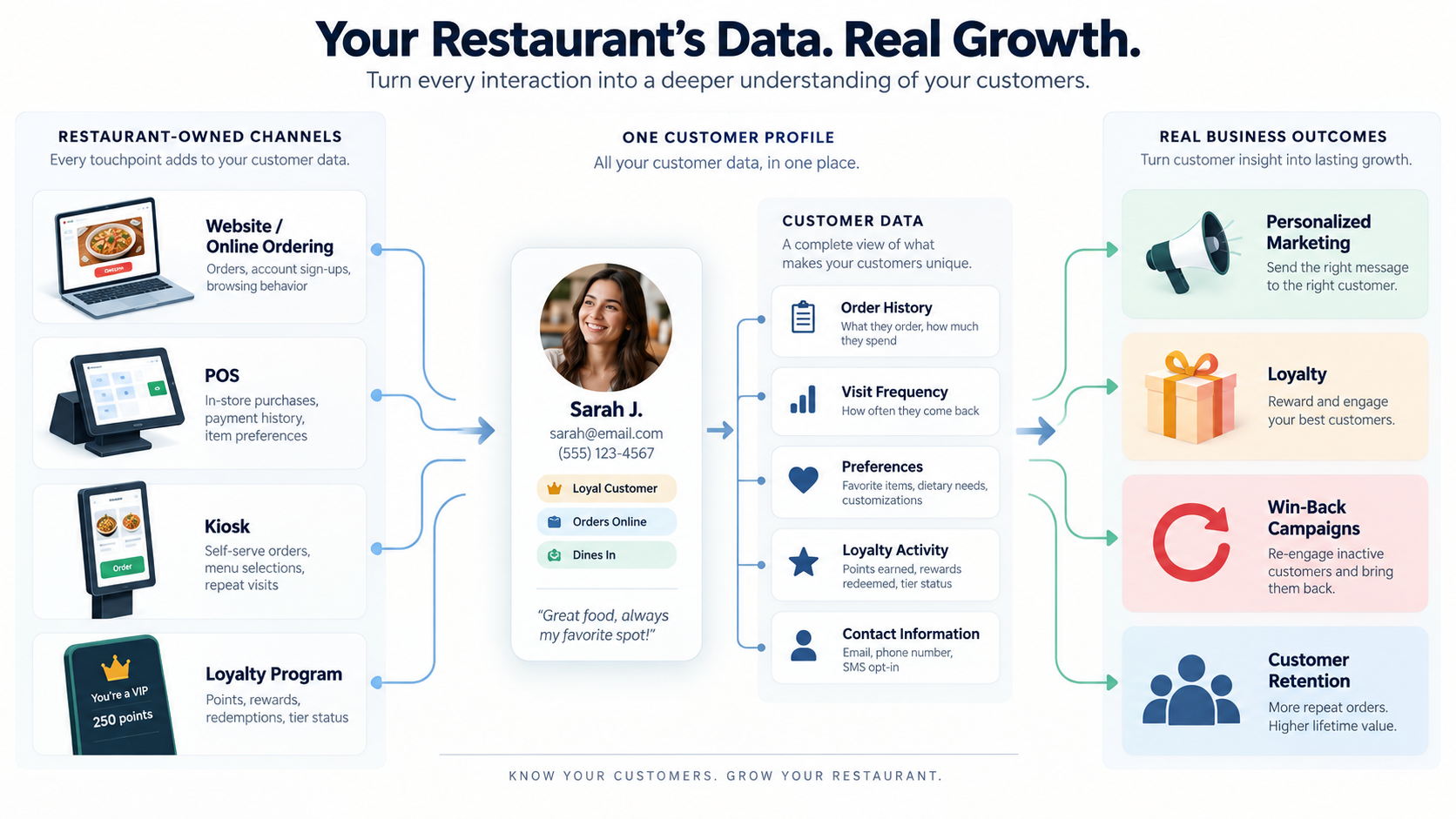
When a customer shares that information directly through channels you control — your website, online ordering system, POS, kiosk, reservations, or loyalty program — it’s called first-party data.
The important part isn’t simply whether you technically “own” a database.
It’s whether your restaurant can access the information, understand the customer, and use it to build a direct relationship.
That distinction matters most when the customer orders through a third-party marketplace.
When someone orders directly from your website, you can recognize that person the next time they order.
When the same person orders through a marketplace, the platform controls much more of the customer relationship.
A recent court case made that distinction unusually clear — and showed why restaurants can’t count on regulation to solve the problem.
In 2021, New York City passed a law requiring food-delivery platforms to share customer information — names, delivery addresses, emails, phone numbers, and order details — with the restaurants those customers ordered from. The city’s findings highlighted the underlying problem: when someone orders through a delivery platform, the restaurant typically receives only a first name, a last initial, and the order contents.
On August 5, 2026, the U.S. Court of Appeals for the Second Circuit struck that law down, ruling that it violated the platforms’ First Amendment rights. The decision means restaurants cannot rely on that law to require platforms to provide the fuller customer information covered by the legislation.
The takeaway for restaurant operators is simple: if you want a direct customer relationship, the most reliable strategy is to collect the information yourself through direct ordering and other first-party channels.
That’s not just a technology issue.
It’s a retention issue.
Why Customer Data Matters More When Loyalty Is Harder to Keep
Restaurant loyalty isn’t something operators can assume anymore.
Tillster’s 2026 Phygital Index found that 45% of U.S. diners said their favorite restaurant chain had changed in the previous year, up from 33% in 2025. The report surveyed more than 2,100 U.S. diners.
In other words, being someone’s “usual” restaurant is becoming less automatic.
You have to give them a reason to come back — and recognize them when they do.
That’s where customer data becomes useful.
Not because a spreadsheet of phone numbers is valuable by itself.
Because order history tells you who your customers are becoming.
Source: Tillster — 2026 Phygital Index Report: https://www.tillster.com/reports/2026-phygital-index-report
A Customer List Isn’t the Goal. A Customer Relationship Is.
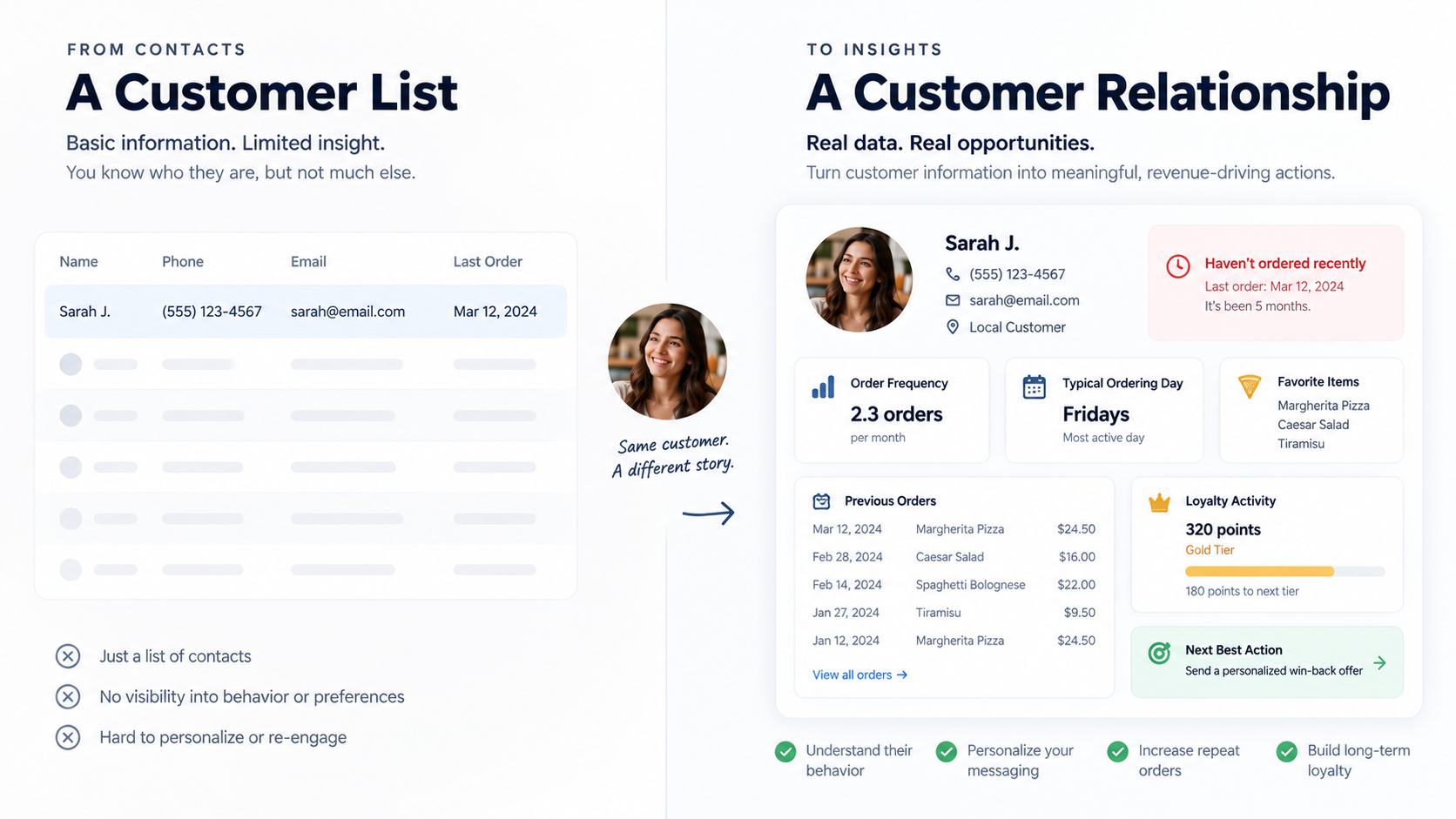
Imagine you know that a customer:
- orders every Friday
• usually gets a large pizza
• hasn’t ordered in 45 days
• has placed six orders in the past year
• always adds wings
• has never tried your new dessert
Now your marketing can be different.
Instead of sending everyone the same 20% off promotion, you can send a win-back message to the customer who disappeared.
You can recommend a new item to someone whose order history suggests they’ll like it.
You can reward a genuinely loyal customer without discounting every other customer.
That’s the difference between having a customer list and knowing your customers.
And the economics of getting that right can be significant.
Toast’s 2026 Regulars Report found that, in Q1 2026, up to 50% of order volume could come from just 7% of guests in its analyzed cohort. Toast’s Q1 2026 loyalty data also found that moving a guest into a loyalty program could shift their return rate from a 7% baseline to nearly 30%.
Your most valuable customers aren’t necessarily the people who ordered yesterday.
They’re the people who keep coming back.
Loyalty Works Best When the Restaurant Actually Recognizes the Guest
A loyalty program isn’t valuable just because it gives away points.
The real opportunity is recognition.
Toast’s 2026 research found that 48% of diners said being remembered by name or by their usual order was what made them feel most valued at a restaurant. Yet only 30% said they always received that level of recognition at the restaurants they visit most.
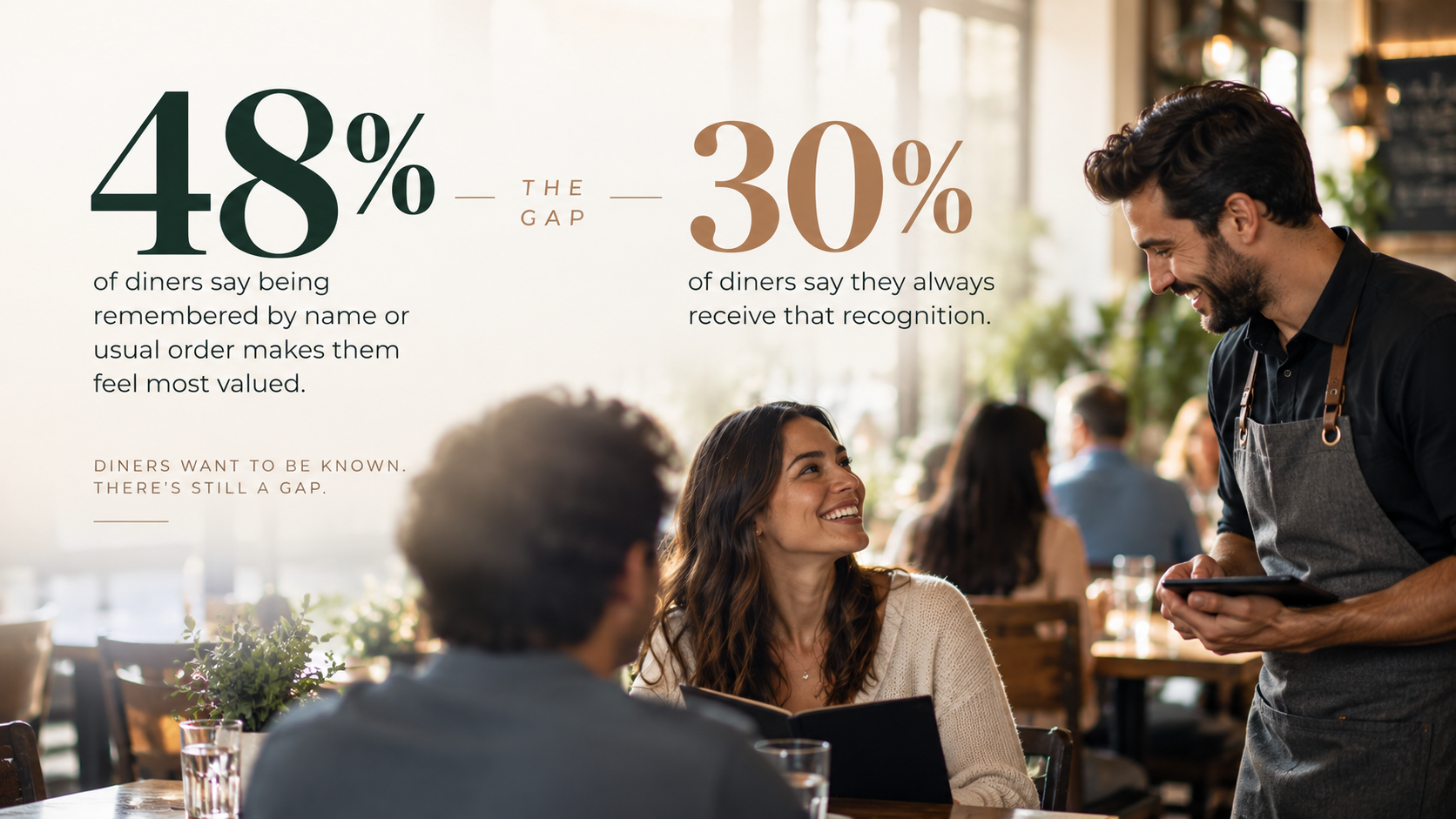
That’s a data problem as much as a hospitality problem.
If your POS knows someone is a regular, your loyalty program knows they’re a member, and your online ordering system knows what they usually buy — but none of those systems connect — the restaurant still doesn’t really know the customer.
The goal isn’t to collect more data.
The goal is to make the data useful.
Your Best Marketing Audience May Already Be in Your Database
This is where email and SMS become particularly powerful.
You don’t always need another advertising campaign to find your next customer.
Sometimes you need to bring back the customer you already paid to acquire.
Toast’s Q1 2026 data found that, among restaurants actively using its marketing tools, 86% of orders attributed to email marketing and 83% of orders attributed to SMS marketing came from people who had already dined at the restaurant.
That’s exactly what retention marketing should do.
Your customer database can become the audience for:
- Win-back campaigns
• Birthday and loyalty messages
• New menu announcements
• Personalized offers
• Reorder reminders
• Seasonal promotions
• High-value customer rewards
• “We haven’t seen you lately” messages
Instead of constantly paying to reacquire the same customer, you build a channel for bringing them back.
Three Questions to Ask Your Technology Provider
Before signing up for a POS, ordering platform, loyalty program, or marketing system, ask:
| Question | What the answer tells you |
| Can I export my customer information and order history? | If you can’t access your customer records, you may be more dependent on the platform than you realize. |
| Does the same customer profile work across POS, kiosk, online ordering, and loyalty? | If every channel creates a separate customer record, your data is fragmented. |
| What happens to my customer records if I cancel? | Understand what you can take with you before you commit. |
The last question is particularly important.
You shouldn’t only ask what a platform can do while you’re paying for it.
Ask what happens to your customer relationship when you leave.
A Real Restaurant Example
This isn’t theoretical.
Innowi customer Pho Ha Plus had been relying heavily on third-party delivery platforms. According to Innowi’s published case study, the restaurant had limited visibility into its delivery customers and did not have access to the email addresses, phone numbers, and order history associated with those marketplace orders.
After moving to Innowi’s direct ordering system, Pho Ha Plus had a branded ordering experience on its own domain, with customer data flowing into its own restaurant ecosystem.
Over two years, the restaurant generated $144,662 in direct online sales across 3,174 direct orders, while saving $28,932 in third-party delivery commissions, according to the case study.
That’s the bigger opportunity behind direct ordering.
It’s not just about avoiding a commission.
It’s about turning an anonymous transaction into a relationship the restaurant can continue building.
Where Innowi Fits
Innowi is built around that idea: your restaurant should have a direct relationship with the people who buy from you.
Innowi’s online ordering platform gives restaurants a branded ordering channel with zero commission on direct orders and customer data connected across the platform.
POS, kiosk, online ordering, loyalty, email, and SMS can work from the same customer ecosystem.
That means an order isn’t just another transaction.
It can become the beginning of a customer relationship.
And that relationship is what brings the customer back.
Your restaurant worked to earn the customer. Your technology should help you keep the relationship.
See how Innowi helps restaurants build direct customer relationships →
Frequently Asked Questions
What is restaurant customer data?
Restaurant customer data is the information a restaurant collects about its guests — contact details, order history, visit frequency, and preferences. When it’s shared directly through channels the restaurant controls, such as its website, POS, kiosk, or loyalty program, it’s known as first-party data.
Can restaurants get customer data from third-party delivery apps?
Access varies by platform, agreement, and applicable law. Restaurants should not assume that marketplace orders automatically provide the same customer information they could collect through their own ordering channels. In 2026, the Second Circuit struck down a New York City law that would have required platforms to share broader customer information with restaurants.
How do restaurants collect first-party customer data?
Through direct online ordering on the restaurant’s own website, loyalty program sign-ups, POS and kiosk profiles, and reservations — always with the customer’s consent. Connecting those systems into one customer profile is what makes the data actionable for win-back campaigns, personalized offers, and retention marketing.