Every year, WSAA tells you where the payments industry’s head is at.
This year, it felt different.
More technology on the floor. More honest conversations about margins. And one very large company showing up in a place nobody expected to see it.
Here’s what we saw, what we heard at our booth, and what we think it means for ISOs and agents heading into 2027.
1. Margins are the elephant in the room
The mood this year was mixed, and the reason came up again and again: margins are shrinking.
Some of the people we talked to were worried about a race on price that could push processing margins toward zero. When everyone competes on rate, nobody wins for long.
The question underneath almost every conversation was simple: who actually provides distinct value?
The sessions pointed the same way. The “Sales Reimagined” panel focused on how ISOs can compete with modern disruptors, and panelists argued for leading with a real benefit to the merchant, not just a lower price. Square’s Mike Collins summed it up for attendees: “You have to lead with technology.”
Our take: Rate alone is no longer a strategy. The stronger pitch is a product the merchant uses every day.
2. Square walked into the ISO channel, and it got people talking
For a lot of us, this was the story of the show.
Square, long known for selling directly to merchants, sponsored the Day One general sessions. Collins, Square’s head of resellers, spoke on the sales panel.
It’s a real shift. According to Digital Transactions, Square has favored direct sales since its 2009 start. Block cofounder Jack Dorsey said in 2024 that Square might enlist ISOs, and after launching an ISO reseller program, Block said in May that it had more than 140 participants.
Reactions on the floor were split:
- Square’s partners were understandably excited.
- Many others were cautious. Will Square stay committed to the channel, or switch back to direct someday? Nobody could answer that with confidence.
Why now? Our read is that it’s at least partly a response to integrated POS competitors like Toast. Digital Transactions noted that integrated platforms can narrow the window in which a sales agent controls the merchant relationship, which makes the channel more valuable to whoever wins it.
Our take: Whatever the motivation, it’s impressive to watch a company that size change its go-to-market strategy this publicly. It also confirms something ISOs already know: the channel still matters.
3. From reseller to platform partner
One session title captured the direction of the whole event: “From Reseller to Platform Partner: Technology’s Role in the Next Payments Era.” It examined how bundling payments with software, hardware, and services is changing how ISOs go to market.
We heard the same thing at our booth, from the other side.
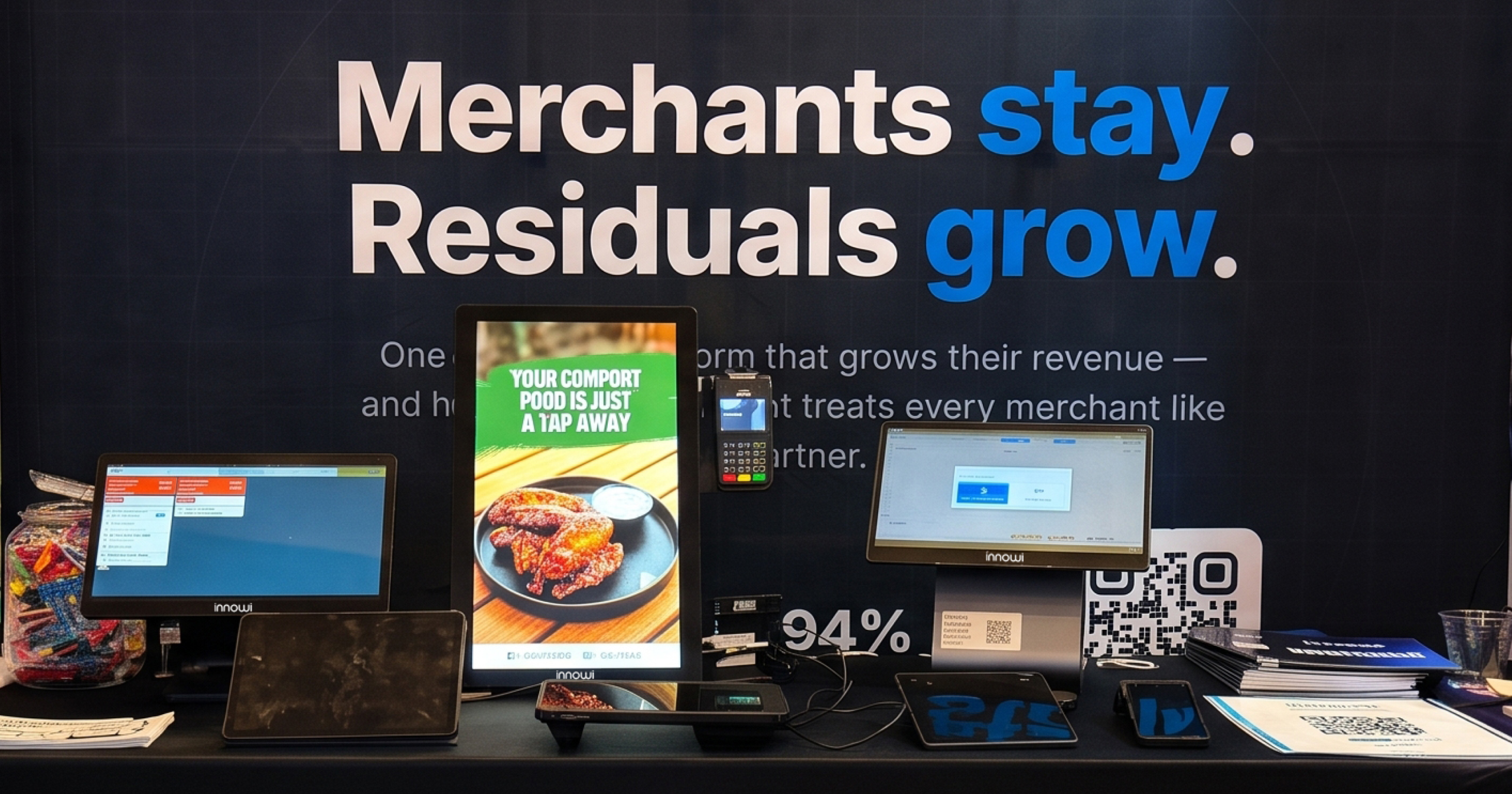
A lot of our conversations were about how an all-in-one restaurant platform has changed things for the partners we work with. Several told us that the older solutions they used to sell were no longer keeping them relevant, for reasons like price, lack of innovation, or lack of support. Moving to a full platform, with POS, ordering, kiosks, and marketing under one roof, gave them something new to bring to merchants.
Our take: The ISO isn’t going away. The ISO who only sells a terminal might.
4. Stablecoins went from “interesting” to “show me the numbers”
Digital currency had its own general session this year: “Unlocking Digital Currency: Opportunities for Merchants and Payments Leaders.” The session covered crypto, stablecoins, and tokenized assets, and how merchants can tap growing wallet adoption.
On the floor, curiosity was high. People didn’t just want to hear about stablecoins. They wanted to see numbers.
The argument that resonated most with the people we spoke to: a lot of money is parked in crypto and stablecoins, sitting on the sidelines. Give that money an easy, familiar way to buy lunch, and it can become new spending at real businesses rather than money that sits idle.
It’s still early, and adoption is still being proven. But this is where Innowi is already building. Separately from WSAA, Innowi announced a partnership with SablePay to bring stablecoin acceptance into restaurant ordering. It’s currently being demonstrated at Boba & Brew and Pita Gyros in San Francisco, where customers scan a QR code, order, pay, and get a text when their food is ready.
Our take: Stablecoins won’t replace cards anytime soon. But ISOs who understand them now will be the ones merchants call when customers start asking.
5. AI moved from experiment to execution
A Day Two session put it plainly: the next phase of AI in payments isn’t about experimenting, it’s about execution.
The practical uses discussed at WSAA were less flashy than the headlines. As Digital Transactions reported, they included statement analysis, generating sales presentations, and round-the-clock support in multiple languages. The goal is to cut administrative work so people have more time for the parts of the sale that need a human.
PayCompass founder Justin Vollrath framed it well: AI should make human interaction faster and more effective, not replace it.
Our take: The agents who use AI to prepare better will outsell the agents who hope AI will sell for them.
6. A new generation is entering the game
This was the most encouraging part of the week.
For all the worry about margins, the industry is still hungry. We met plenty of newer, younger people who came to WSAA specifically to learn the new technology and build the next chapter of this industry. They weren’t there to protect an old model. They were there to play the new game.
That’s healthy. Payments was built by people who adopted new technology early. It looks like that’s happening again.
What this means for ISOs heading into 2027
Our honest advice: jump on the new technology.
This industry was built on innovation. When card processing arrived, the people who embraced it built the businesses that exist today. Now it’s time for the next round: payments and new technology working together.
But the goal hasn’t changed. It’s still about helping merchants run better businesses. If that’s the real goal, then every tool, every technology, and every innovation that helps them is worth learning and adopting.
A few practical steps:
- Audit what you sell. If your main pitch is rate, you’re in the race to zero. Find the product a merchant will use every day.
- Learn stablecoins now. You don’t have to sell them tomorrow. You do need to answer the question when a merchant asks.
- Use AI for the prep work. Statement analysis, proposals, and follow-ups are where it saves real time today.
- Pick partners who’ll still be around. Ask any platform, Square included, how committed it is to the channel over the long term.
Were you at WSAA 2026? Let’s compare notes
I’d love to hear what you took away. And if you couldn’t make it this year, I’m happy to fill you in on what I saw.
>Book a time with me or connect with me on >LinkedIn. You can also reach our partner team at partners@innowi.com or learn about the Innowi partner program.
Shayan Toor, Chief Growth Officer, Innowi
Sources
- >WSAA 2026 Agenda (Western States Acquirers Association)
- >WSAA 2026 Sessions and Speakers (Western States Acquirers Association)
- >WSAA 2026 Attendee Registration (Western States Acquirers Association)
- >About WSAA (Western States Acquirers Association)
- >Square Doubles Down on Its Renewed Interest in ISOs as a Sales Channel (Digital Transactions, Sept 17, 2026)
- Innowi partners with SablePay to bring stablecoin payments into everyday restaurant commerce (Innowi, Sept 2026)